Recently, I viewed a very funny video about the many meanings of 'shit.' Although I have taught such common four letter words in the past, I wondered how my colleagues and friends (native English speakers and non-native English speakers) would respond to a query about teaching 'shit' to my intermediate-level adult students at a community college. Out of 10 people who responded via FB or email, not one of them waivered. They all said, "Yes, you should teach bad words." One even said that it is my 'responsibility' to teach them.
Here's the video. The performer is Finnish and definitely has a great sense of American English. I don't know if he was a comedian in his native country, but he definitely tickles my funny bone.
What do you think? I did show this video to my students, and most of them (a dozen) enjoyed it. However, a few didn't seem to 'get' it. When you explain humor, it somehow kills it, so I had a brief follow-up reaction/reflection talk, advising caution (especially to the young adult males in my class) when attempting to use this kind of language with native speakers.
I agree it IS my responsibility as an instructor of English to non-native speakers to teach them awareness and self-consciousness when using four-letter words that can be seen as obscene or irreverent. I also want them to understand that context is extremely important - how powerful a definite or indefinite article is in changing the meaning of an expression. As a student of many foreign languages (Spanish, French, Quechua, Japanese, Arabic, Lingala), I find it easy to put myself in the position of my students. I would want to know these words in other languages I have studied to greater or smaller degrees, so that I might understand if someone is insulting or complimenting me. It is up to each student to take what I've chosen to give, store it in memory, or throw it away.
Showing posts with label funny English. Show all posts
Showing posts with label funny English. Show all posts
Monday, January 7, 2019


Sunday, June 1, 2014
Teaching Sarcasm in English
When teaching intermediate-level students how to become better listeners, we often advise them to listen for differences in intonation or word choice that might signal meanings that are different from the dictionary definition of the words themselves. Learning to make inferences or to infer meaning from the way people express themselves in a foreign language can be daunting.
Some of my students who don't recognize the word sarcasm have difficulties understanding it from a written definition, so besides using examples from their textbook, Listening Power 3, I offer them some free online examples linked to my wiki. It is helpful for students to be able to listen to audio tracks or video examples outside of class.
The first one here is from the BBC's Learning English website. It gives a student some insight into English or British culture and a few audio examples of what sarcasm sounds like. The next is a link to a popular American TV series called The Big Bang Theory (TBBT). In this segment of an episode, one of the main characters Sheldon is trying to learn what sarcasm is. This video clip reinforces the explanation given by the BBC.
Personally, I'm not a fan of sarcasm as it was not part of my personal background. I didn't encounter it much until I was in high school. As explained in the BBC Learning English track, not every culture uses sarcasm as a form of humor. When dealing with non-native speakers, especially, but also with native speakers of English who you don't know well, be careful about using sarcasm. If the person you are interacting with doesn't know that you're being ironic or sarcastic, (s)he could misunderstand you and be hurt by your words. Sarcasm when aimed at a person unfamiliar with this form of communication can feel like an insult or a put down.
Some of my students who don't recognize the word sarcasm have difficulties understanding it from a written definition, so besides using examples from their textbook, Listening Power 3, I offer them some free online examples linked to my wiki. It is helpful for students to be able to listen to audio tracks or video examples outside of class.
The first one here is from the BBC's Learning English website. It gives a student some insight into English or British culture and a few audio examples of what sarcasm sounds like. The next is a link to a popular American TV series called The Big Bang Theory (TBBT). In this segment of an episode, one of the main characters Sheldon is trying to learn what sarcasm is. This video clip reinforces the explanation given by the BBC.
Personally, I'm not a fan of sarcasm as it was not part of my personal background. I didn't encounter it much until I was in high school. As explained in the BBC Learning English track, not every culture uses sarcasm as a form of humor. When dealing with non-native speakers, especially, but also with native speakers of English who you don't know well, be careful about using sarcasm. If the person you are interacting with doesn't know that you're being ironic or sarcastic, (s)he could misunderstand you and be hurt by your words. Sarcasm when aimed at a person unfamiliar with this form of communication can feel like an insult or a put down.
Wednesday, May 14, 2014
"Beat It," "Eat It," and "West Side Story"
To teach students the concept of parody along with count and noncount nouns, students first listened to a young Michael Jackson singing and dancing to "Beat It " (1982) Then they watched Weird Al Yankovic in a video parody called "Eat It" (1984). Students examined the lyrics (or words) to Weird Al's song, examining nouns for countability. It was difficult at times to understand the food references without knowing brand names such as Captain Crunch, Raisin Bran, and Spam. Much more could have been done with this song in a literature or reading class, and I hope I'll have a chance to try the materials again with another high intermediate or advanced level group.
***You can also go back in movie history and watch an excerpt from "West Side Story" (1961) which the Michael Jackson dance video seems to parody. There are other excerpts which seem relevant to "Beat It", such as the scene where Tony tries to break up the fight between two gangs, the Jets and the Sharks. The scene parallels Michael Jackson's role in "Beat It," except Michael, of course, is able to get the two gangs to dance out their hostility.
Friday, April 11, 2014
Funny Translations from Chinese to English
The hardest thing to convey to students, especially lower level ESL students, is not to use a translating dictionary to write in English. Here are some very funny examples of signs (you may need to click on the replay button for Gallery after you get to the first photo) that obviously don't say what was meant. Most (all?) of them are apparently mistranslations or literal translations from Chinese to English. We hope that no one was injured by following some of the directions.
Even though there may be some pretty good translating programs online, creating signs are a challenge even to native speakers. To avoid this kind of comedic representation of English, it is essential to have a native speaker of English or a bilingual bi-cultural speaker of Chinese and English verify the spelling and meanings of signs before they go up in public. I have no doubt that Americans translate to other languages in the same fashion as the Chinese. As I pointed out here, we don't even make signs very comprehensible to our own people.
I hope that we can, however, all enjoy the many colorful Englishes used around the world and appreciate the effort that non-native speakers of English (who far outnumber us native speakers of English!) make to apply or master our tongue.
Even though there may be some pretty good translating programs online, creating signs are a challenge even to native speakers. To avoid this kind of comedic representation of English, it is essential to have a native speaker of English or a bilingual bi-cultural speaker of Chinese and English verify the spelling and meanings of signs before they go up in public. I have no doubt that Americans translate to other languages in the same fashion as the Chinese. As I pointed out here, we don't even make signs very comprehensible to our own people.
I hope that we can, however, all enjoy the many colorful Englishes used around the world and appreciate the effort that non-native speakers of English (who far outnumber us native speakers of English!) make to apply or master our tongue.
Thursday, March 13, 2014
More Really Funny English!
Some of you may have seen this set of 31 photos trending on Facebook. If you haven't yet, I hope you enjoy these very funny English translations of Chinese. As with most humor, explaining and analyzing the translation may destroy its hilarity. You'll know that you understood a sign correctly if you are chuckling to yourself or sometimes holding your sides from laughing so hard. Always keep your sense of humor.
Sunday, February 9, 2014
Buzzwords
What are buzzwords? They are words or phrases that are popular during a certain period of time. Sometimes they're trendy technical terms that are used to make those people who don't keep up with technological or social trends feel out of touch with what "newsmaking" people are talking about or doing. Should you pay attention to buzzwords?
If you're an ESL instructor, it's probably a good idea to notice buzzwords since your more ambitious students may hear them in the news or on a TV show or in a night club and ask you for a definition. The problem for most teachers is that it's impossible to monitor all media, so the best you can do is to send students to sites that attend to these new (or re-activated) words that regularly pop up. Cambridge Dictionaries Online has a useful blog that focuses on buzzwords. Another well-known publisher Macmillan also has a list by date of trending words.
At the end of the year, the Wall Street Journal (WSJ) published an article about words that "popped" in 2013. I often spend a bit of time going over these annual reflections and ask myself which words I heard or used last year. They include expressions such as twerk, Obamacare, cronut, drone, selfie, Thanksgivukkah, bitcoin, and lean in.
If you're a real "wordie," you should check out lexicographer Ben Zimmer's blog. There are numerous links to articles that he's published over the years (including the above Wall Street Journal article), and he often responds to tweet queries about origins of expressions. There is another article on buzzwords from WSJ entitled "Which Buzzwords Would You Ban?" but this is currently accessible only to online subscribers. Words from that list include expressions like push the envelope, out-of-the-box thinking, passionate, and viral. For a look at another sample of words to banish from business use, you should examine LinkedIn's "Top 10 Overused LinkedIn Profile Buzzwords of 2013." You can also be a part of the next survey of "buzzwords to ban in 2014" by visiting and leaving your input at WSJ's "At Work" column.
*****
Attention, teachers! Here's a link to several lesson plans using Macmillan's dictionary resources on buzzwords.
If you're an ESL instructor, it's probably a good idea to notice buzzwords since your more ambitious students may hear them in the news or on a TV show or in a night club and ask you for a definition. The problem for most teachers is that it's impossible to monitor all media, so the best you can do is to send students to sites that attend to these new (or re-activated) words that regularly pop up. Cambridge Dictionaries Online has a useful blog that focuses on buzzwords. Another well-known publisher Macmillan also has a list by date of trending words.
At the end of the year, the Wall Street Journal (WSJ) published an article about words that "popped" in 2013. I often spend a bit of time going over these annual reflections and ask myself which words I heard or used last year. They include expressions such as twerk, Obamacare, cronut, drone, selfie, Thanksgivukkah, bitcoin, and lean in.
If you're a real "wordie," you should check out lexicographer Ben Zimmer's blog. There are numerous links to articles that he's published over the years (including the above Wall Street Journal article), and he often responds to tweet queries about origins of expressions. There is another article on buzzwords from WSJ entitled "Which Buzzwords Would You Ban?" but this is currently accessible only to online subscribers. Words from that list include expressions like push the envelope, out-of-the-box thinking, passionate, and viral. For a look at another sample of words to banish from business use, you should examine LinkedIn's "Top 10 Overused LinkedIn Profile Buzzwords of 2013." You can also be a part of the next survey of "buzzwords to ban in 2014" by visiting and leaving your input at WSJ's "At Work" column.
*****
Attention, teachers! Here's a link to several lesson plans using Macmillan's dictionary resources on buzzwords.
Monday, June 17, 2013
More Signs for Building Vocabulary
As you know from previous posts, I enjoy signs in English. Not only can they be funny, but they contain a lot of useful vocabulary for non-native English speakers. Recently, while surfing the web, I found this great link at ManyThings. It has an extensive set of photos of signs in English. Please do have a look.
I've also included a list of some of my previous posts about signs (1, 2, 3, 4). Enjoy!
P.S. This is an amusing one which works best if you know who Johnny Cash, Bob Hope, and Steve Jobs were, and who Kevin Bacon is.
I've also included a list of some of my previous posts about signs (1, 2, 3, 4). Enjoy!
P.S. This is an amusing one which works best if you know who Johnny Cash, Bob Hope, and Steve Jobs were, and who Kevin Bacon is.
Sunday, June 2, 2013
Another Funny English Headline
Today my husband set aside a page from our local newspaper because of a very funny headline. This one got by the editor(s), but there must have been numerous readers who called in about the error in word choice/word form. The headline in the paper edition was
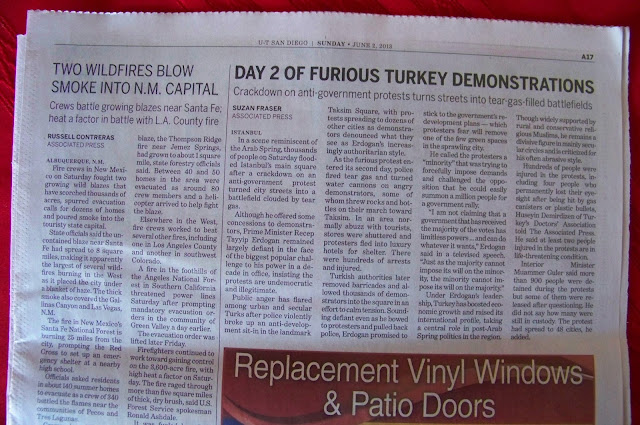 "Day Two of Furious Turkey Demonstrations"
 "Day Two of Furious Turkey Demonstrations"
I looked for the link online before photographing the newspaper. The online edition had been correct(ed) as you can see here.
Do non-native speakers understand why the original headline is so hilarious or strange? Do you know the bird "turkey," which Americans eat at Thanksgiving? This headline seems to be announcing that turkeys are furious and demonstrating for the second day. I wonder if UT San Diego will make a formal apology since the above use of English error makes the reader start off laughing about something serious.

Saturday, March 10, 2012
Why is English Cool?
English is my business. These days it seems like that's all that I think about and do - whether it's putting together a literature review for a graduate class in TESOL or teaching ESL in an IEP (Intensive English Program).
I can't remember where I ran across the following reference. I believe it was a link from a Facebook friend. It comes from www.freerepublic.com although it's, in my view, primarily for our amusement with the English language - and not to promote conservative politics.
You should definitely have a look at the numerous comments posted after checking out the list of sentences. The replies contain even more funny (haha-funny and strange-funny) English. The polysemous nature of my language makes it an endless source of fascination.
I can't remember where I ran across the following reference. I believe it was a link from a Facebook friend. It comes from www.freerepublic.com although it's, in my view, primarily for our amusement with the English language - and not to promote conservative politics.
You should definitely have a look at the numerous comments posted after checking out the list of sentences. The replies contain even more funny (haha-funny and strange-funny) English. The polysemous nature of my language makes it an endless source of fascination.
Sunday, October 16, 2011
"Chinglish"
Besides teaching English as a Second Language, I have a long-term interest in other Englishes. Chinglish, of course, is the word we sometimes humorously use to refer to the kind of English spoken by Chinese who are non-native speakers of English. This post, however, is partly about "Chinglish", the new play that was performed this summer in Chicago and is moving on to New York and (I hope, eventually) the West Coast.
Why did Davide Henry Hwang write the play "Chinglish"? It was in response to his experiences traveling in China. Despite his Asian roots, he discovered, as I have when I go to Japan, that our American upbringing compels us to see connections and disconnections between cultures and people's behavior and language. If we all speak in English, are we actually communicating?
First, I will give you a link to a funny YouTube video which streams a lot of Chinglish signs (some of which you may have seen at Engrish.com) with a nonsensical-sounding song. Next, you can play the game linked to the Broadway play, "Chinglish", to get you in the spirit of the performance. The answers are here if you want to skip the game. Finally, these are some links to a description of the play: interviews with the cast and the playwright (1, 2) and a review in the Chicago Sun Times. Cheers to Davide Henry Hwang and success to Chinglish!
Saturday, October 2, 2010
Japanglish in Kyoto

I did mind my step (British English). In addition, the sign warns, 'When crossing [Japanese script], be careful of the footing sufficiently. Understand beforehand because the responsibility cannot be assumed about the accident in case and so on.'
I did take my time following the stone pathway in Ginkakuji's garden in Kyoto. Fortunately, I didn't have 'the' accident. Since I was by myself, I don't have a picture to prove it, but here's one of a fellow tourist who successfully crossed the large pond as I did. ;-)

Sunday, August 1, 2010
Fun with Puns
What's a pun? According to the Collins Advanced Dictionary of American English, a pun is "a clever and amusing use of a word or phrase with two meanings, or of words with the same sound but different meanings." If you can 'get' (=understand) these, you are most likely an advanced level user of English.
The following came from Barron's, August 2, 2010, printed edition:
1. 'Santa's helpers are subordinate clauses.'
2. 'A hangover is the wrath of grapes.'
3. 'She was engaged to a boyfriend with a wooden leg but broke it off.'
Friday, June 18, 2010
Watch What You Say!
One of my favorite song cloze activities uses 'The Logical Song' by Supertramp. Whenever I play the music, almost every student struggles with the expression, 'Watch what you say!' When I ask them, 'What would you yell if someone were about to cross the street and a car was coming?' and I give the clue, '_____ out!', they usually give me the correct word. Then I proceed to give other examples from real-life situations.
To illustrate other uses, I tell them about a very tall, non-native speaker who was boarding a small commuter flight from San Diego to L.A. The stewardess stood at the top of the staircase and told passengers to 'watch your head.' My husband was behind the guy who failed to lower his head and smashed into the top of the door. There's another incident which was related to me by one of my Korean students. He rode the bus to school and one morning decided to leave by the front door. When the door opened, he was about to step down when the driver warned, 'Watch your step!' Upon hearing the remark, the student didn't step down and turned to look at the driver. She repeated the comment, 'Watch your step.' The student stood staring at the step, not knowing why he should look at the step. He turned to the bus driver again, and she repeated the warning. Meanwhile, people were waiting to get on the bus. Finally, the student looked at the driver and commented in frustration, 'I AM watching the step!' The bus driver shook her head in disgust and said, 'Whatever....' The student got off the bus, blushing, and realized as soon as he stepped down that she was simply trying to tell him to be careful as he stepped off of the bus.
Most non-native speakers don't quite 'get' these expressions because they're brief and sometimes sound like little niceties, rolling off native speakers' tongues and correctly assumed to be ones for which there are no required responses, other than a nod of the head. My student paid attention to the expression, actually trying to understand the words and its meaning.
"Watch out!", "Watch your head", and "Watch your step" are American expressions that are used very similarly to the British English expression "Mind your head" and "Mind your step." Mind what you say. Mind your manners!
Here are some other examples in context: from Tony and Thomas's amazing Contemporary Nomad blog, and another from a newspaper article. Now maybe you won't slip and fall, step on a spiny fish, or bump your head when you see or hear these warnings.
To illustrate other uses, I tell them about a very tall, non-native speaker who was boarding a small commuter flight from San Diego to L.A. The stewardess stood at the top of the staircase and told passengers to 'watch your head.' My husband was behind the guy who failed to lower his head and smashed into the top of the door. There's another incident which was related to me by one of my Korean students. He rode the bus to school and one morning decided to leave by the front door. When the door opened, he was about to step down when the driver warned, 'Watch your step!' Upon hearing the remark, the student didn't step down and turned to look at the driver. She repeated the comment, 'Watch your step.' The student stood staring at the step, not knowing why he should look at the step. He turned to the bus driver again, and she repeated the warning. Meanwhile, people were waiting to get on the bus. Finally, the student looked at the driver and commented in frustration, 'I AM watching the step!' The bus driver shook her head in disgust and said, 'Whatever....' The student got off the bus, blushing, and realized as soon as he stepped down that she was simply trying to tell him to be careful as he stepped off of the bus.
Most non-native speakers don't quite 'get' these expressions because they're brief and sometimes sound like little niceties, rolling off native speakers' tongues and correctly assumed to be ones for which there are no required responses, other than a nod of the head. My student paid attention to the expression, actually trying to understand the words and its meaning.
"Watch out!", "Watch your head", and "Watch your step" are American expressions that are used very similarly to the British English expression "Mind your head" and "Mind your step." Mind what you say. Mind your manners!
Here are some other examples in context: from Tony and Thomas's amazing Contemporary Nomad blog, and another from a newspaper article. Now maybe you won't slip and fall, step on a spiny fish, or bump your head when you see or hear these warnings.
Friday, April 30, 2010
Is that English?
I happened to run across this amusing clip while I was searching for information about non-human primates. It is part of an interview between Ellen DeGeneres and Actor Hugh Laurie where they test each other's knowledge of British and American English slang. Not all of the expressions were familiar to me, but the exercise highlights the difference between these two Englishes.
Sunday, April 11, 2010
Colorful English in Southeast Asia
Some friends who have been traveling throughout Asia for more than two years have a blog (Contemporary Nomad) which recently posted some more examples of English from the 'field.' Some of the signs are amazingly similar to others posted in European hotels, warning guests not to use accommodations for indecent or inappropriate behavior. One wonders if the abusers can understand the funny English. It's a good thing they have some pictures too.
Saturday, February 6, 2010
Funny English, Part 5?
A while ago I went through a period of searching for funny or strange English online and in my surroundings. Recently I browsed the internet and came up with an amusing list of tourist signs from a site I hadn't visited before. There are some repeats (at the end of the list) of previously posted collections. Nevertheless, this page on 'StrangeCosmos' provides a comprehensive, amusing view of creative English.
Sunday, September 13, 2009
Should We Teach Four-Letter Words?
I often tell students to stick their necks out, risk humiliation, and use their English as often as possible. Male students, however, often want to use those profane four-letter words, like 'fu_k!' and 'sh_t!' They seem to think it makes them 'sound' more 'native' or perhaps 'cool.' Some say they use these expressions even in their own languages. Great.
I haven't seen any statistics about non-native speakers who use profanity being better received or perceived by natives. But, at least, in my classes, I let students know that 'fu_k!' is not an appropriate word to yell out when their team doesn't get a word in Taboo or Hot Seat (vocabulary games). And it is totally inappropriate to yell 'Fu_k you!' at a female salesclerk who decides not to sell a student a package of cigarettes because she doesn't recognize a foreign passport as proof of age - no matter how absurd her decision might have appeared to this male student.
Another problem with non-native speakers getting in the habit of using some common expletives is that they might not be able to control their use in formal situations. For example, I had a cute blond female FCE (Cambridge First Certificate in English) student who used 'sh_t!' during her first practice test interview. In Part 2 of the interview, she was given a set of pictures that she found difficult to describe in English, and her initial reaction was to say, 'Oh, sh_t!' Although this student was tape-recorded and the entire class heard her inappropriately using the expression, she repeated the error during the second practice exam. ('Sh_t!') Unfortunately, this student did not pass the test. I hope it wasn't because she used that four-letter word when she wasn't supposed to.
Last week, a thoughtful, mild-mannered Korean student who teachers are very fond of and who has made great progress in learning English practiced a new expression from his host dad. What was the idiom? 'I don't give a sh_t!' Apparently, on the back of the host family's car, there was a bumper sticker with these words on it. When the student asked what the words meant, the dad explained that they mean, 'I don't care.'
Thinking that the expression was simply another way to say that, the student tried it out both in the classroom and in an essay. Of course, the outcome was quite embarrassing as his morning teacher was quite shocked to hear him using the expression in conversation practice in the classroom. The evening before, I was also startled to see the same expression appear in a description of his weekend in L.A. The student was trying to express the idea that although it was very hot in the city, he had enjoyed himself. 'Because I was with two beautiful girls and a guy friend, I didn't give a shit.' I could sort of understand what the student meant, but it was definitely unexpected in the context of the writing assignment.
Personally, I believe that ESL teachers should let students know what these four-letter words mean if the topic comes up in class but, in general, to advise students against using them in public or with strangers. This also includes other expressions, such as 'God damn it!', 'Holy shit!', 'asshole!' or 'bitch!' Know what they mean, but don't make a habit of using them. That's my rule.
Nevertheless, for those of you who disagree, here's a clip of a documentary film dedicated to the f-word, and some other expressions using the word 'shit' from an online dictionary.
I haven't seen any statistics about non-native speakers who use profanity being better received or perceived by natives. But, at least, in my classes, I let students know that 'fu_k!' is not an appropriate word to yell out when their team doesn't get a word in Taboo or Hot Seat (vocabulary games). And it is totally inappropriate to yell 'Fu_k you!' at a female salesclerk who decides not to sell a student a package of cigarettes because she doesn't recognize a foreign passport as proof of age - no matter how absurd her decision might have appeared to this male student.
Another problem with non-native speakers getting in the habit of using some common expletives is that they might not be able to control their use in formal situations. For example, I had a cute blond female FCE (Cambridge First Certificate in English) student who used 'sh_t!' during her first practice test interview. In Part 2 of the interview, she was given a set of pictures that she found difficult to describe in English, and her initial reaction was to say, 'Oh, sh_t!' Although this student was tape-recorded and the entire class heard her inappropriately using the expression, she repeated the error during the second practice exam. ('Sh_t!') Unfortunately, this student did not pass the test. I hope it wasn't because she used that four-letter word when she wasn't supposed to.
Last week, a thoughtful, mild-mannered Korean student who teachers are very fond of and who has made great progress in learning English practiced a new expression from his host dad. What was the idiom? 'I don't give a sh_t!' Apparently, on the back of the host family's car, there was a bumper sticker with these words on it. When the student asked what the words meant, the dad explained that they mean, 'I don't care.'
Thinking that the expression was simply another way to say that, the student tried it out both in the classroom and in an essay. Of course, the outcome was quite embarrassing as his morning teacher was quite shocked to hear him using the expression in conversation practice in the classroom. The evening before, I was also startled to see the same expression appear in a description of his weekend in L.A. The student was trying to express the idea that although it was very hot in the city, he had enjoyed himself. 'Because I was with two beautiful girls and a guy friend, I didn't give a shit.' I could sort of understand what the student meant, but it was definitely unexpected in the context of the writing assignment.
Personally, I believe that ESL teachers should let students know what these four-letter words mean if the topic comes up in class but, in general, to advise students against using them in public or with strangers. This also includes other expressions, such as 'God damn it!', 'Holy shit!', 'asshole!' or 'bitch!' Know what they mean, but don't make a habit of using them. That's my rule.
Nevertheless, for those of you who disagree, here's a clip of a documentary film dedicated to the f-word, and some other expressions using the word 'shit' from an online dictionary.
Saturday, July 11, 2009
A Funny Message
Last month I traveled to Switzerland where I met up with several former students. At the hotel in Zurich, I received the following typed message from the clerk at the front desk:
"Mrs. Hofer call me and she leave a massage for you: Friday 19th
2009 around 7pm is the Meetingpoint Bahnhof ok. Mrs. Hofer reserved a restaurant."
"Mrs. Hofer call me and she leave a massage for you: Friday 19th
2009 around 7pm is the Meetingpoint Bahnhof ok. Mrs. Hofer reserved a restaurant."
Sunday, May 3, 2009
George Carlin and Playing on English
A few weeks ago, I saw a recording of an award ceremony commemorating (posthumously) the comedic talents of George Carlin, who was being honored with the Mark Twain Prize at the Kennedy Center. Listening to some of his most famous routines, I realized what a genius he was with words and wondered why I had never seriously explored his work. Take, for example, the first two minutes of his 'Advertising Lullaby.' It's an outstanding demonstration of all the advertising come-ons used in the business, but presented in such an artful way that it was pleasurable listening to it. He always considered the rhythm and sounds and carefully chose the sequence in which to put the phrases together. You can be totally mesmerized by his 'poetry in motion.' The only drawback is that, depending on the age of your students and your own sensitivity, you may need to censor the last 40 seconds of this piece. There's a lot of vulgarity in the last part. This link gives you a transcript of the lyrics without the last stanza.
Of course, George Carlin devotes some attention to seven dirty words that can't be used on television (this excerpt again would not be appropriate for school-age children). Had he not used so many 'unacceptable' words, his work would be ideal for any advanced level ESL class. His abundant profanity, however, requires caution when airing his pieces. Nevertheless, the fact that the Kennedy Center did celebrate his achievements last November, shows that he went beyond notoriety to achieve recognition as a major contributor to the development of the art of American humor.
Advanced-level students, if you can understand George Carlin's work, then you're probably near proficiency level! If you can't yet enjoy this form of entertainment, download, read and interpret the transcript of 'Advertising Lullaby.' Watch the performance again, and just listen to the music of the American spoken word interpreted by George Carlin.
Of course, George Carlin devotes some attention to seven dirty words that can't be used on television (this excerpt again would not be appropriate for school-age children). Had he not used so many 'unacceptable' words, his work would be ideal for any advanced level ESL class. His abundant profanity, however, requires caution when airing his pieces. Nevertheless, the fact that the Kennedy Center did celebrate his achievements last November, shows that he went beyond notoriety to achieve recognition as a major contributor to the development of the art of American humor.
Advanced-level students, if you can understand George Carlin's work, then you're probably near proficiency level! If you can't yet enjoy this form of entertainment, download, read and interpret the transcript of 'Advertising Lullaby.' Watch the performance again, and just listen to the music of the American spoken word interpreted by George Carlin.
Sunday, April 5, 2009
Fun with English
Everyone loves to have fun with English. Studying sentences designed for native speakers of English can help ESL students who are preparing for an FCE or CAE exam. If you don't understand what's funny or strange about the expressions, ask me here in a comment, or ask another native speaker.
Since the Cambridge Exams seem to be examining students' knowledge of some idiosyncrasies of English as well as their general understanding and ability to use it, you might enjoy the following examples of language play. A post from buzzle.com lists more than 50 sentences that contain homonyms or pose questions about the irregularities of English. Very advanced level students might get the humor in the sentences in this very popular post at Writing English.
Since the Cambridge Exams seem to be examining students' knowledge of some idiosyncrasies of English as well as their general understanding and ability to use it, you might enjoy the following examples of language play. A post from buzzle.com lists more than 50 sentences that contain homonyms or pose questions about the irregularities of English. Very advanced level students might get the humor in the sentences in this very popular post at Writing English.
Subscribe to:
Posts (Atom)